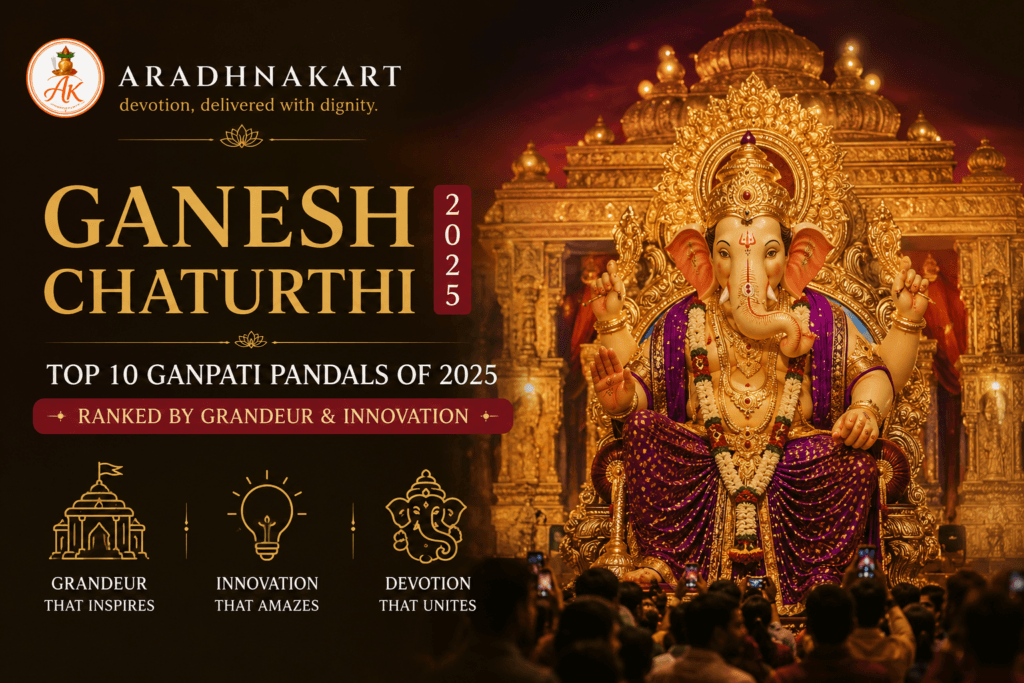
Ranked by Grandeur and Innovation
Every year, the ten days of Ganesh Chaturthi turn Mumbai, Pune, and Hyderabad into open air galleries of faith. In 2025, the festival ran from 26 August to 6 September, and the pandals once again competed on two very different scales. One is grandeur, meaning scale, gold, and sheer devotional pull. The other is innovation, meaning the idea, the theme, and the craft behind the mandap.
This ranking blends both. It rewards the mandals that pulled the largest crowds and the ones that took the boldest creative swings. Wherever an entry earned its place mainly on originality, it is flagged as a most innovative pick.
1. Lalbaugcha Raja, Mumbai
No list starts anywhere else. Known as the Navsacha Ganpati, the fulfiller of wishes, Lalbaugcha Raja marked its 92nd year in 2025 and once again drew close to a million and a half devotees a day, with the legendary Navsachi Line stretching for hours. The idol, sculpted by the Kambli family who have shaped it for more than 80 years, appeared in a striking purple attire under a golden mandap. The 2025 theme drew on the Tirupati Balaji darshan, giving the whole setup a South Indian temple grandeur. It stays the emotional center of the entire festival.
Ranked here for: unmatched scale and devotional pull.
2. GSB Seva Mandal, King’s Circle, Mumbai
If Lalbaugcha Raja is the most beloved, GSB Seva Mandal is the richest. In 2025 the mandal insured its celebrations for a record 474.46 crore rupees, up from 400.58 crore the previous year. The idol is adorned with more than 69 kg of gold and 336 kg of silver, almost all of it donated by devotees, and it is the one mandal where rituals run round the clock according to Rigvedic tradition. It is opulence with a clean, disciplined devotional core.
Ranked here for: record breaking scale and craftsmanship.
3. Dagdusheth Halwai Ganpati, Pune (Most Innovative)
Pune’s most iconic mandal, established in 1893, is famous for reimagining a different landmark temple each year. In 2025 the trust recreated Kerala’s Padmanabhaswamy Temple, with artisans from Kerala and Maharashtra collaborating on the gopuram, the carvings, and the gold like finish. The programming went beyond decoration, featuring Kathakali and Carnatic performances and Onam inspired floral arrangements. It is one of the finest examples of a pandal used as a cultural bridge across regions.
Ranked here for: the year’s boldest thematic concept.
4. Khairatabad Ganesh, Hyderabad (Most Innovative)
Hyderabad’s giant delivered again. In its 71st year, the 2025 idol stood 69 feet tall under the theme Vishwa Shanti Maha Shakti Ganapati, carrying a message of world peace, and was flanked by Kanyaka Parameshwari and Gajjelaamma Mata. What makes it notable is not only the height but the pivot to eco friendly clay and natural colors at that enormous scale, proving that record size and sustainability can coexist. It was immersed in Hussain Sagar after a grand Shobha Yatra.
Ranked here for: monumental scale paired with an eco conscious build.
5. Mumbaicha Raja, Ganesh Galli, Mumbai
A short walk from Lalbaugcha Raja, Mumbaicha Raja is the quiet master of craft. Its 22 foot idol has been handcrafted without moulds for 45 years, a rare feat of pure artisanship. The mandal is celebrated for imaginative themes that swing from temple models to mythological scenes, and despite its famous neighbor it consistently rewards visitors with a more intimate, design led experience.
Ranked here for: idol craftsmanship and inventive themes.
6. Raja Tejukayacha, Mumbai (Most Innovative)
This is the sustainability standout of Mumbai. The Tejukaya mandal builds its idol from eco friendly materials such as paper, gunja, coconut husk, and natural paint. In 2025 the 22 foot Ganesha appeared in a warrior avatar, tying together devotion, artistry, and a genuine environmental statement. As immersion rules increasingly favor artificial tanks and greener idols, Tejukayacha reads like a preview of where the festival is heading.
Ranked here for: leading the eco friendly movement in a big city mandal.
7. Kasba Ganpati, Pune
Pune’s Gram Daivat, or guardian deity, Kasba Ganpati holds the first place among the city’s five Manache Ganpati. Established by Jijabai, the mother of Chhatrapati Shivaji Maharaj, it carries centuries of history. It is the first idol installed and the first immersed, setting the rhythm for the entire city. In 2025 it leaned into cultural heritage with traditional decorations, classical music, and subtle lighting that framed its famous simplicity.
Ranked here for: heritage and ceremonial primacy.
8. Andhericha Raja, Mumbai
One of Mumbai’s longest running mandals, Andhericha Raja is best known for its Aagman Sohala, the grand arrival procession, and for a calmer, ritual first atmosphere. The idol is not the tallest in the city, but the mandal’s emphasis on tradition, smooth crowd management, and a serene spiritual aura makes it a favorite for devotees who want depth over spectacle.
Ranked here for: procession culture and devotional calm.
9. Tulshibaug Ganpati, Pune
Tulshibaug is the mandal to watch for large scale visual storytelling. It is renowned for a towering idol and decorations that change dramatically every year, often built around mythological narratives. Set inside a busy market district and glowing with LED and floodlight arrangements, it delivers the kind of larger than life spectacle that pulls lakhs of visitors each season.
Ranked here for: scale of decor and mythological storytelling.
10. Khetwadi Ganraj, Mumbai
Rounding out the list, the Khetwadi lanes are famous for producing some of Mumbai’s tallest idols, historically reaching the 30 to 40 foot range, and the area has been a hub of artistic experimentation since the late 1950s. It offers a concentrated pandal hopping trail where several mandals in a small radius push each other on height and theme, making it one of the most rewarding stretches for anyone chasing craft.
Ranked here for: towering idols and a dense cluster of creativity.
The two winners
If the festival handed out two crowns in 2025, they would go to different pandals.
Best overall goes to Lalbaugcha Raja. Nothing else matches its combination of scale, history, and raw devotional gravity.
Most innovative goes to Dagdusheth Halwai Ganpati for the Padmanabhaswamy Temple recreation, with Khairatabad Ganesh a very close second for pairing a 69 foot idol with an eco friendly clay build.
Planning your own pandal trail
A few practical takeaways from the 2025 season. Group your visits by city cluster rather than chasing every idol, since Lalbaug, Ganesh Galli, and King’s Circle sit close together in Mumbai, and Kasba, Tulshibaug, and Dagdusheth form a natural Pune circuit. Use local trains, metro, or special darshan bus routes, because parking near major pandals is almost impossible. Go early in the morning to beat the heaviest queues, and if you are visiting for immersion, choose artificial ponds to support the eco friendly shift that mandals like Tejukayacha and Khairatabad are now championing.
Whichever way you rank them, the story of 2025 was the same as always. Faith at an enormous scale, craft that keeps reinventing itself, and a city wide devotion that turns ten days into a spectacle no other festival quite matches.