If you’ve ever stood in the early-morning crowd at Kashi Vishwanath, or watched a kanwariya jatha walk through your city in Sawan, one thing becomes obvious — devotion to Shiv ji operates on a different frequency.
Mahadev’s bhakti has a raw intensity to it. Not delicate flowers but datura and aak. Not silk garments but a tiger skin. Not laddoos but bhang. The simplicity in Bhole baba’s worship isn’t a lack of sophistication. It is the sophistication. Stripped down to essentials. No theatrics, no performance.
This article walks through who Shiv ji is, how his pooja is traditionally performed, what each piece of samagri represents, and which texts every devotee should know.
The Shiv Philosophy — Destruction Means Transformation
In the Hindu trinity, Brahma creates, Vishnu preserves, and Shiv destroys. But this destruction is not apocalyptic. It is transformative — the end of the old, the beginning of the new. Which is why Mahadev is also called Shankar: the one who brings auspiciousness.
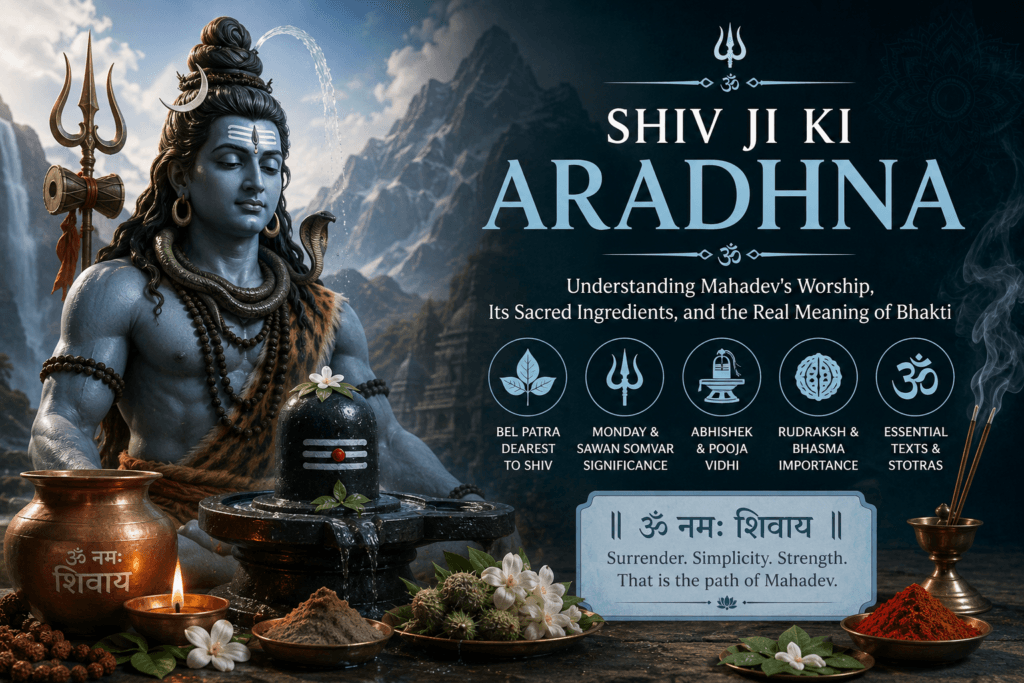
Every Shiv image carries this philosophy in its details. The Ganga flowing from his hair — purity in motion. The crescent moon on his forehead — a calm, cool mind. The serpent around his neck — mastery over fear. The bhasma smeared across his body — a constant reminder that everything eventually returns to dust, so don’t get too attached. The trishul in his hand — control over the three gunas, and over past, present, and future. Nandi at his feet — strength paired with humility.
This is why he’s called Bhole. Whether you’re powerful or poor, polished or rough — in front of Mahadev, everyone stands equal.
And don’t think of Shiv ji and Shakti as separate. Maa Parvati is his ardhangini, and in the Ardhnareeshwar form, the two are literally one being — half Shiv, half Shakti. No Shiv without Shakti. No Shakti without Shiv. That is what cosmic balance actually means in this tradition.
Why Monday is Shiv ji’s Day
Every deity in the Hindu tradition has a designated day. Shiv ji’s day is Somvar — Monday.
The word “Som” means moon, and the moon sits on Mahadev’s forehead. According to Puranic katha, when Daksh cursed Chandrama, the moon performed intense tapasya to Shiv ji, who then placed him on his own head. From that point on, Somvar became his day.
The month of Sawan (July–August) belongs to him entirely. Sawan Somvar — Mondays during Sawan — carry the greatest weight of all. Some devotees observe four Sawan Somvar vrats, others fast for the entire month.
Here’s something worth clarifying — the vrat isn’t really about making Mahadev happy. Bhole baba is already pleased by sincere intent. Fasting and discipline exist for the devotee, not the deity. They are tools for focus, restraint, and sankalp. They are for you.
The Shiv Ling — What It Actually Represents
In many mandirs, you’ll find a Shiv ling instead of a sculpted murti. The reason is theological.
The Shiv ling is the symbol of the formless. Vedic tradition holds that Brahman — ultimate reality — is nirakaar, without form. The Shiv ling embodies this concept. The Sanskrit word “linga” simply means “sign” or “mark.” So the Shiv ling is the cosmic sign of that which has no shape, no boundary, no description.
The worship sequence is straightforward, but every step has meaning. First comes jal abhishek — bathing the linga with pure water, often Ganga jal. In Sawan, devotees often offer milk. Then comes bel patra, followed by bhasma, chandan, and fresh phool. Dhoop and agarbatti are lit, a ghee diya is offered, and the pooja closes with “Om Namah Shivay” jap and the Shiv aarti.
Simple in form. Layered in meaning.
The Samagri — and Why Each Item Matters
Every ingredient in Shiv ji’s pooja carries its own philosophy. None of it is decorative.
Bel patra (Bilva patra) — The most important offering. It is a trifoliate leaf — three leaflets joined at one stem. Tradition holds that these three represent the three eyes of Shiv ji, or the trinity, or the three gunas. It is always offered upside down, smooth side facing the linga.
Bhasma — Sacred ash. The same ash that covers Mahadev’s body. A constant reminder of mortality — everything returns to ash eventually, so let the ego go. Traditionally comes from havan or from cow dung that has been ritually purified.
Rakta chandan — Red sandalwood. Chandan has a cooling, calming quality. Rakta chandan, with its deep red colour, has been used in Shiv pooja for centuries.
Rudraksh — “Rudra” plus “aksh” — the eye of Rudra, another name for Shiv ji. Tradition holds that rudraksh beads were born from Shiv ji’s tears. Used both as a mala for jap and worn for spiritual protection.
Ganga jal — Pure water from the Ganga. Since Ganga ji descended through Shiv ji’s matted hair, Ganga jal is considered essential for his worship.
Datura and aak ke phool — While other deities receive only beautiful flowers, Mahadev accepts datura and aak — wild, even toxic plants that other traditions avoid. This reflects his ascetic nature. He accepts what others reject.
One important traditional rule — kumkum and haldi are not offered to Shiv ji. The reasons vary across traditions, but the practice itself is consistent.
The Essential Shiv Texts — Chalisa to Tandav Stotram
Shiv Chalisa — Forty chaupais composed in praise of Mahadev. Recited daily or at minimum on every Somvar. The text builds a layered portrait of Shiv ji — destroyer, ascetic, householder, compassionate protector. Slow it down. Sit with the meaning.
Shiv Aarti — “Om jai Shiv omkara, Swami om jai Shiv omkara…” The most widely sung Shiv aarti. Performed at the close of pooja with a lit diya rotated before the deity while a bell is rung.
Shiv Tandav Stotram — The most intense piece in the entire Shiv canon. Attributed to Raavan. The story: Raavan attempted to lift Mount Kailash. Shiv ji simply pressed down with his toe, pinning Raavan beneath the mountain. To beg forgiveness, Raavan composed this stotram. The Sanskrit cadence is extraordinary — the rhythm of the verses actually mimics tandav, the cosmic dance. Sung, chanted, even rapped today, and somehow it works in every form.
Mahamrityunjaya Mantra — “Om tryambakam yajamahe sugandhim pushtivardhanam…” From the Rig Veda. Recited for healing, longevity, and protection from untimely death. One of the most powerful mantras in the entire Hindu tradition.
Panchakshari Mantra — “Om Namah Shivay.” Five syllables. No special time, no special samagri, no preparation needed. Chant it walking, sitting, in a mandir, in traffic. The simplest and most powerful mantra in the tradition.
Daily Shiv Pooja at Home — A Simple Routine
Visiting a Shiv mandir is important, but mandirs aren’t always nearby. A daily pooja at home has its own place in the tradition.
After a morning snan and a change into clean clothes, clean the pooja sthal. Sit before Shiv ji’s image or Shiv ling. Offer a small jal arpan. If fresh bel patra is available, offer it — otherwise any seasonal flower works. Apply chandan or bhasma. Light a ghee diya, then agarbatti and dhoop.
Start with “Om Namah Shivay” — at least eleven repetitions, ideally twenty-one or one hundred and eight. If you have time, recite the Shiv Chalisa. End with the Shiv aarti.
The whole thing takes fifteen to twenty minutes. On Somvar, give it slightly more time — offer kheer or a white sweet as bhog, and consider keeping a vrat if your health and schedule allow.
Mahashivratri, Sawan, and Pradosh — The Major Shiv Parv
Mahashivratri — Falls on the krishna paksha chaturdashi of the month of Phalgun (February–March). Tradition holds that this is the night Shiv and Parvati were married. Devotees stay awake through the night with jagran, mantra jap, and vrat. The biggest Shiv parv of the year.
Sawan — The entire month of Shravan, dedicated to Mahadev. The kanwar yatra takes place during this month — lakhs of devotees carry Ganga jal from Haridwar or Gangotri back to their local Shiv mandir on foot. Sawan Somvars are considered especially auspicious.
Pradosh vrat — Falls twice a month — on the trayodashi of both krishna and shukla paksha. Another day dedicated to Bhole baba’s worship.
Modern Devotion — and Where Fragrance Fits In
Modern life compresses both time and space. The good news is, Shiv bhakti was never meant to be complicated. A single bel patra, a lit diya, a sincere “Om Namah Shivay” — Mahadev has always accepted offerings made with shraddha, no matter how small.
But when you do sit down for pooja, fragrance does meaningful work. Agarbatti and dhoop aren’t lit only because they smell good. They shape the atmosphere of the space. They help the mind settle, slow the breath, mark the moment as separate from the rest of the day. And when the fragrance itself aligns with the deity being worshipped — the leafy freshness of belpatra, the grounded earthiness of bhasma, the warm intensity of rakta chandan — the pooja deepens.
This is exactly the thinking behind the Shiv Aradhna line at Aradhnakart:
🔱 Shiv Aradhna Agarbatti — Belpatra & Bhasma Designed specifically for Mahadev’s pooja. Bel patra’s fresh, leafy top notes meeting bhasma’s grounded, earthy depth. Suited for daily Somvar pooja or any occasion of Shiv aradhna. Shop Now
🔱 Shiv Aradhna Dhoop Sticks — Rakta Chandan Pure rakta chandan infused dhoop. Deep, warm, sustained fragrance — particularly well suited to the evening aarti and major parv like Mahashivratri and Sawan Somvar. Shop Now
🔱 Shiv Aradhna Sambharni Cup — Bhasma Authentic bhasma-based traditional dry dhoop. Burns in a cup, releases gentle smoke, carries that unmistakable temple-like fragrance. Brings the experience of a Shiv mandir into your home. Shop Now
All three are hand-rolled by women self-help group artisans. Natural ingredients only — no synthetic chemicals, fragrances chosen according to Vedic tradition.
Har Har Mahadev.